
Feature Articles
How this young S’porean with autism gains confidence and independence through work
6 January 2026
Once uncertain about his future after leaving school, 19-year-old Imaan Zulkifli holds a job through the Dignity of Work programme that is supported by the President’s Challenge [The Straits Times | Published Jan 05, 2026, 04:00 AM]
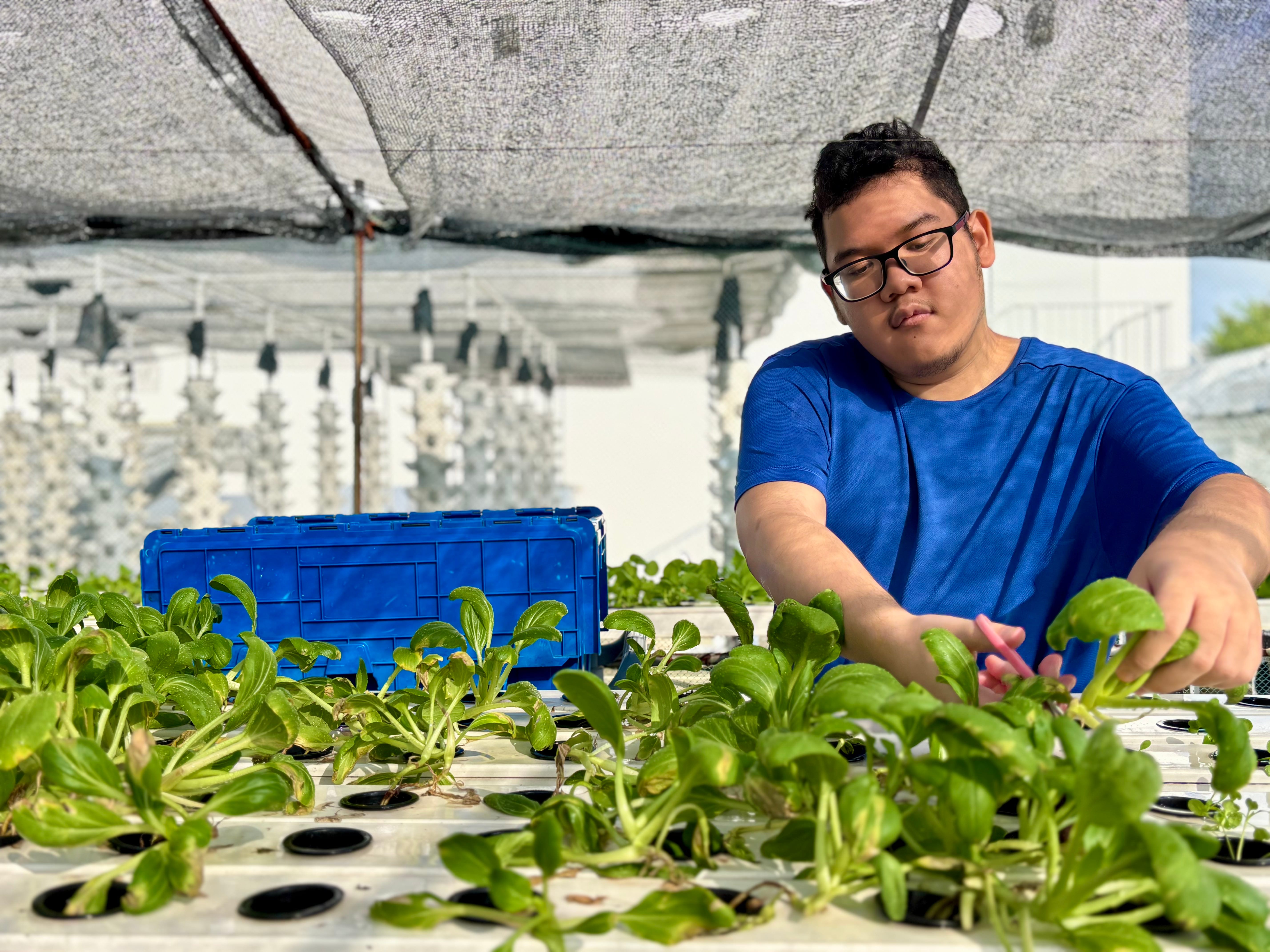
Caption: As part of the Dignity of Work programme, Imaan Zulkifli tends to vegetables at the St Andrew’s Autism Centre urban farm. PHOTO: ST ANDREW’S AUTISM CENTRE
At the rooftop farm of St Andrew’s Autism Centre (SAAC), 19-year-old Imaan Zulkifli tends patiently to trays of herbs and vegetables, careful with every sprout and leaf. Around him, his peers work quietly under the guidance of a job coach.
This is a far cry from a year ago when he found himself cooped up at home after graduating from SAAC at age 18.
Imaan is enrolled in the SAAC’s Dignity of Work (DoW) programme, which is supported by the President’s Challenge. Designed for persons with moderate autism who are not yet ready for open employment, the programme offers a supported work environment where trainees like Imaan can thrive.
The President’s Challenge has been refreshed from 2025 to focus on achieving a more sustained social impact – particularly by uplifting aspirations, abilities and potential among those facing greater challenges in life.
Under this new direction, the President’s Challenge now backs programmes that create lasting change. Its longer-term funding model commits resources for at least three years – rather than one-off funding – giving social service agencies and charities time to build their capabilities and scale social innovations.
Each morning, Imaan and his colleagues cultivate, harvest and package herbs and vegetables at SAAC’s urban farm. The produce is sold to restaurant partners and community fridges, giving their work tangible value. They earn a modest stipend and, more importantly, a deep sense of pride.
“Having a job gives our children a chance to show that they can contribute meaningfully and lead independent lives,” says Mr Zulkifli. “They may think differently, but they are just as able as others.”
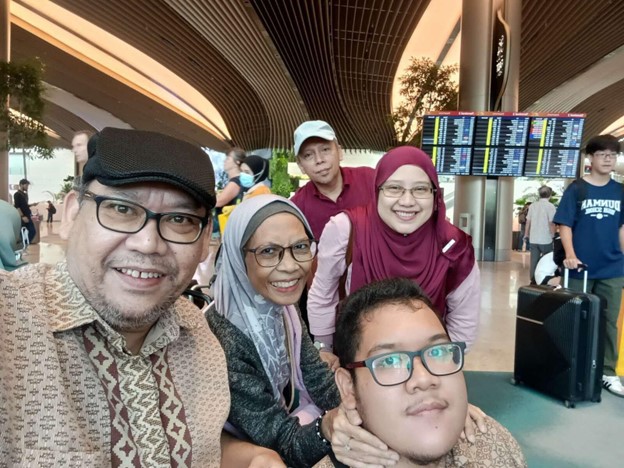
Imaan (bottom right) with his parents and relatives, is now more confident and has fewer meltdowns. PHOTO: COURTESY OF ZULKIFLI ABU JALIL
Imaan was diagnosed with moderate autism spectrum disorder at the age of five. His father Mr Zulkifli, then a financial advisor, took time off work to focus on early intervention. There were daily exercises to strengthen Imaan’s grip, therapy sessions at hospitals, and courses for the family to learn how best to support him.
The turning point came when he enrolled at St Andrew’s Autism School (SAAS) at the age of seven. Over the next decade there, he blossomed. He discovered a love for art and cooking, and gradually learnt to manage his emotions. Over time, he became more independent and is now able to care for himself and even help around the house.
But the progress he has made risked slipping away after he graduated from school last year.
For many youths with disabilities, turning 18 marks a difficult transition — often referred to as the “post-18 cliff”. Once they leave the school system, structured learning, therapy and peer interactions suddenly end, leaving a gap in daily engagement and development. Without continued support, much of their hard-won progress can be lost.
“Every morning, he would still ask to go to school,” recalls Mr Zulkifli. “We had to show him photos of his graduation to help him understand that school was over.”
These days, Imaan is able to travel independently to and from his workplace, though his parents still drop him off and pick him up. What used to be long, empty hours at home are now filled with purpose. He is thriving in a structured and supportive environment that encourages him to socialise with others, learn new skills and take pride in what he does.
Stories like Imaan’s reflect the aim of the President’s Challenge.
At the launch of the President’s Challenge 2025 in May, President Tharman Shanmugaratnam said Singapore is at a stage of development as a country where intangibles matter greatly.
He said the ultimate objective of the President’s Challenge is to build a community of respect.
“All the programmes we’re supporting aim not just at meeting immediate needs, but uplifting people – by discovering talents and developing their potential,” he said.
“We uplift people not just through financial resources being put in the game, not just by opening up opportunities, but also by helping them develop that intrinsic motivation to go further. And the respect we lend each other is the most powerful source of intrinsic motivation – knowing that you can do it. Everyone can do it. That’s how we rise together,” he said.
To turn this vision into reality, corporate partners like SingHealth play a crucial role.
“After two decades of supporting the President’s Challenge, we recognised that a sustained partnership approach allows us to build deeper, more meaningful relationships with the communities we serve,” says Professor Ng Wai Hoe, group chief executive officer of SingHealth.
“This commitment ensures our support creates transformative, lasting change rather than temporary relief.”
Earlier this year, Changi General Hospital (CGH) rallied 38,000 SingHealth staff across 13 institutions, raising $1.41 million in support of the President’s Challenge 2025. One of the benefitting programmes supported is SAAC’s DoW programme.
Among those volunteers is Ms Tan Poh Choo, assistant director of Community Nursing at CGH, who volunteered at SAAC last year.
“Participating in President’s Challenge initiatives at SAAC has taught me humility, patience and empathy,” she says. “Most importantly, it reminds me that our work isn’t transactional – it’s about building a more inclusive and caring society.”
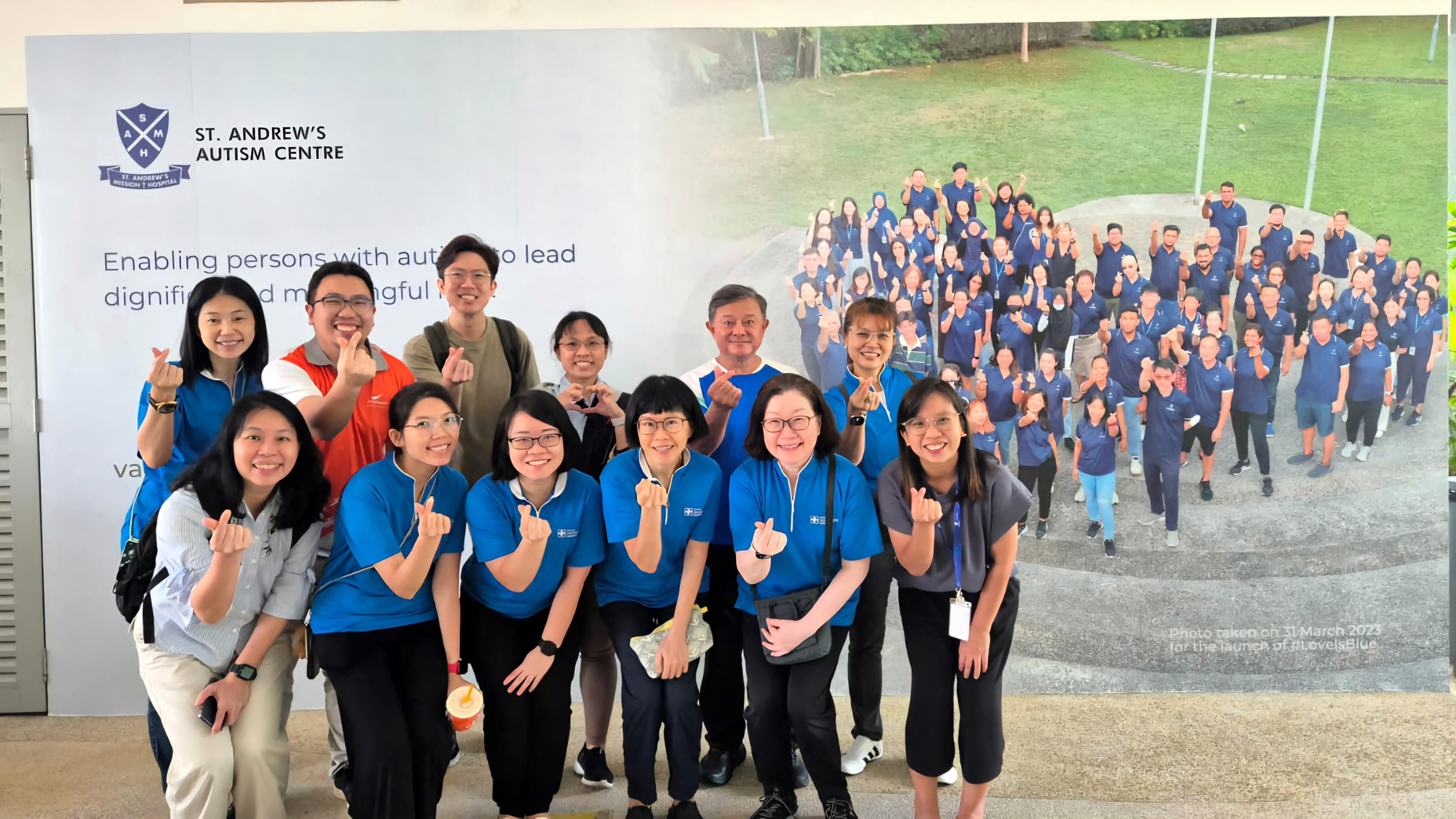
SingHealth volunteer Tan Poh Choo (first row, third from right) with colleagues during a volunteering session at SAAC. PHOTO: COURTESY OF TAN POH CHOO
For Imaan, the impact of that empowerment is clear. He looks forward to his work at the urban farm each day. Two of his former classmates are there too, making the experience even more meaningful.
His father has noticed quiet but significant changes in him.
“He’s more confident now, and more aware of money and responsibility. He has fewer meltdowns and he spends less time on his phone. We’re very proud of how far he’s come.”
Mr Zulkifli hopes more employers and community members will look beyond differences and see the person – and the potential – in every individual.
“What people with special needs seek most is understanding, not pity,” he says. “If employers are patient and willing to guide them, they’ll see how hardworking and loyal these individuals can be. Inclusion is about giving them space to learn and express themselves in their own way.”